Wait for what will come, p.1
Wait for What Will Come, page 1


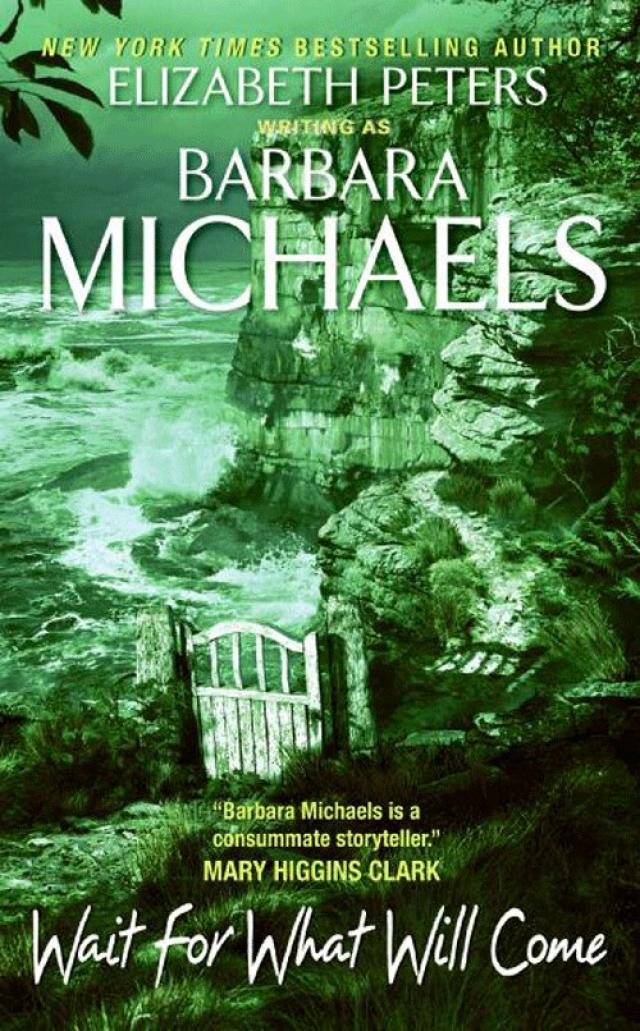
Wait For What Will Come
ELIZABETH PETERS
WRITING AS
BARBARA
MICHAELS
Contents
Chapter 1
CARLA TREGELLAS—BORN 1952, AND VERY MUCH alive—was also…
Chapter 2
WHEN CARLA AWOKE THE NEXT MORNING, IT TOOK her several…
Chapter 3
CARLA GOT OUT OF THE ROOM, AND THE HOUSE, before…
Chapter 4
WHEN CARLA CAME DOWN THE STAIRS AT SEVEN o’clock, she…
Chapter 5
CARLA CLAWED FRANTICALLY AT HER MOUTH. SHE had had time…
Chapter 6
IN THE FIRST MOMENTS, WAKING WAS ONLY A CONTINUATION of…
Chapter 7
ALAN CALLED NEXT MORNING. MRS. PENDENNIS CAME to tell her…
Chapter 8
“WHAT THE HELL IS THE MATTER WITH YOU?”
Chapter 9
CARLA CAME DOWN LATE NEXT MORNING, BUT apparently the rest of…
Chapter 10
DAWN WAS BRIGHTENING THE SKY BEFORE MICHAEL returned from the…
Chapter 11
WHEN CARLA AWOKE NEXT MORNING, HER FIRST conscious emotion was…
About the Author
Praise
Other Books by Barbara Michaels
Copyright
About the Publisher
Chapter
1
In summer, when the sun beams down from an azure heaven, the sea surrounding this rocky promontory has a smiling, innocent face. Golden gorse and purple heather nestle in the fissures of the caverned granite cliffs. The waves splash gaily onto the silver sands of the cove and play among the rocks, twinkling and winking. As the sun sinks slowly in the west, the vault of heaven resembles a painter’s palette, splashed with sublime hues of crimson and cerulean blue, with a lone star pinned like a diamond upon the bosom of the night. In the dying hush of day, one may fancy one can hear the distant chiming of the sunken churches of Lyonesse.
—Diary of Caroline Tregellas, born 1762, died (?) 1780
CARLA TREGELLAS—BORN 1952, AND VERY MUCH alive—was also thinking about the beauties of nature and the fabled cliffs of Cornwall as she approached the home of her ancestors for the first time. She was not stirred to rapturous appreciation. On the contrary, she muttered profanely under her breath and brooded on the disadvantages of living in a mechanized world.
Her rented Austin, inching its way through the streets of Exeter, was one in a line of similar vehicles, all emitting clouds of noxious fumes. The air was blue with exhaust and with the comments of frustrated motorists. She had the choice of leaving the car windows down and getting the full effect of the poisonous gases, or rolling them up and being overcome with the heat.
She had been naive to suppose that England in general, and Cornwall in particular, would be any different from the rest of the so-called civilized world. It was early June, and the Cornish coast was one of the playgrounds of England; she might have known that the traffic would be as bad here as it was between Boston and the Cape, or between Baltimore and the Bay resorts. Like those vacation centers of her native United States, Cornwall was a tag-end of land almost entirely surrounded by ocean, and therefore reachable by only a few limited routes. These were bound to be crowded with tourists.
The guidebook, and the man at the car-rental agency, had warned her to avoid Exeter, and she had had every intention of following that advice. But it wasn’t easy to read road signs while concentrating on keeping to the left. And where had she gotten the idea that England was a cool, moist country? It was unseasonably hot, even for Cornwall, which is sometimes referred to by effusive tour guides as the English Riviera.
However, after she crossed the Tamar her sour mood improved, and she was forced to admit that even in the twentieth century Cornwall had its charms. The road followed the coastline, which was rocky, high, and rugged. From the top of the cliffs she had occasional breathtaking glimpses of the ocean and of little villages clinging picturesquely to the steep slopes. No wonder the towns built around these rock-bound harbors had prospered in the days of England’s maritime glory. Falmouth and Plymouth, Penzance and St. Ives—the familiar names gave her a sense of homecoming. Some had been transferred by homesick emigrants to a similar landscape thousands of miles to the west, others familiarized by a literary tradition, from folk legend to Gilbert and Sullivan, that is the heritage of the entire English-speaking world…. But for her it was more than that. Her spirits quickened as the miles rolled out behind her, and she found her thoughts returning to the interview with the Boston lawyer, only a few weeks earlier. Yes, in the most primitive sense of the word, she was coming home.
II
“Roots?” Carla threw her head back and laughed. “No, Mr. Fawcett, I can’t say I’ve ever had any wild desire to pursue mine.”
The lawyer looked at her in surprised approval. She had a nice laugh, and the change of expression did wonders for her face. He had thought, when she first came into the office, that she was a solemn little thing, too grave and serious for a woman of twenty-six. The smile illumined her features, lent sparkle to her eyes, and emphasized the unusual delicacy of her bone structure.
Mr. Fawcett knew Carla’s age and other personal details, although this was the first time they had met. He had found her appearance unusual in several ways. Knowing that the family was of Cornish stock, he had expected that the strong Celtic strain would be visible. He was a closet anthropologist, was Mr. Fawcett—and, although he would have denied it vigorously, something of a poet—and he now realized, with an unprofessional and not wholly comfortable thrill, that he was seeing an example of a racial strain far older than the Celtic, so old that its history had become the fabric of legend and folklore. The little dark people who had inhabited England in prehistoric times had been pushed back into the far corners of that island by the Celtic warriors, just as the Celts were to be pushed, in their turn, by later invaders. Into Cornwall, Scotland, and Wales, across the stormy gray waters into Ireland the beleaguered remnants of a dozen races had fled, and had stopped, their backs to the watery walls. There was nowhere else to go. Invasion came from the east, from the continent; and beyond the western limits of Britain was nothing but endless sea, and the Islands of the Blessed.
Some scholars claimed that there was a strong Mediterranean strain in the Cornish, and there was archaeological evidence to support the theory. The isle of Britain, lost in the cold mists of the northern seas, had been the goal of intrepid seafarers from the time of Odysseus. There are Minoan axes carved on the monoliths of Stonehenge, and Phoenician merchants had founded fortunes on the tin trade, jealously guarding their maps of the northern sea routes.
Seeing Carla Tregellas, Mr. Fawcett found these theories more plausible than ever. If he had not known better, he might have taken her for a Greek or a southern Italian, with her thick dark hair and warm coloring. Yet there was something in her face that was alien to those practical, earthy people: a hint of other wordliness in the wide-spaced gray eyes and sharply cut features. Her ears, exposed by the short, tousled haircut, were small and delicate; Mr. Fawcett might have used the word “pointed” if his vein of poetry had not been so deeply buried. The little dark people, hunted like animals by the invaders, had gone underground; according to some scholars, they had become the pixies and elves of English folklore….
Mr. Fawcett shook himself mentally, surprised and shocked at the track his thoughts were following. There was something about the girl that induced fantasy; the quality must be strong, to have such an effect on an elderly lawyer who prided himself on his common sense.
Certainly her manner did not support his wild ideas. Her tone was brisk and matter-of-fact, her ideas practical, as she went on:
“Of course I knew the family came from Cornwall. Where else, with a name like Tregellas? ‘By Tre, Ros, Pol, Lan, Caer and Pen, you may know most Cornishmen.’ I’ve read a few novels about the country, seen things on TV—but I never did any genealogical research. I mean, why should I? I suppose I took it for granted that the family was poor and obscure. I know many Cornishmen came to this country in the nineteenth century, after the tin mines failed and they couldn’t find work.”
She paused, waiting for him to comment, and Mr. Fawcett started guiltily. He had been fantasizing again. But really, those eyes of hers were quite remarkable. So dark a gray that in a certain light they looked black; but at times—when she smiled, for instance—they became a luminous silver, reflecting every emotion.
Come, now, Mr. Fawcett told himself sternly. This won’t do. Whatever is the matter with you?
“Your attitude is understandable,” he said primly. “Until the success of the book to which you referred, genealogical research was a hobby of the middle-aged. Young people are not usually concerned with the past. And there is some truth in your surmise that the family—your branch of it, at least—was poor and of little consequence.”
“I didn’t say they were of little consequence,” Carla said. “The word I used was ‘obscure.’”
“What? Oh—oh, yes. I see what you mean. Er—are you at all interested in the history of your family?”
“Not much.”
“You are an outspoken young woman, aren’t you?”
“I’ve been told so.” Carla smiled at him, and his momentary pique evaporated. “I’m sorry,” she went on. “Tell me what you think I need to know. I guess I can’t get out of this situation without taking some
“Quite right. Very well, then, you must understand that your great-great-grandfather, William Tregellas, was the proverbial younger son. There is some story of a quarrel with his father, which resulted in his being disinherited. In fact, there was little for him to inherit at that time. The family is very ancient, actually, but it fell into decline after the Civil War—the English Civil War, that is, between—”
“I know about the English Civil War,” Carla said, with a faint smile. “Cromwell and King Charles. I suppose my family supported the king? Stupid of them.”
“Quite so,” said Mr. Fawcett, unreasonably irritated by this cynical observation. Cynicism did not suit those wide gray eyes. “Hmph. In any case, it was not until the nineteenth century, after William had left for America, that a cousin of his restored the family fortunes. For a time there was a great deal of money. However, modern taxation has accomplished what war and disaster did not do. The money is gone. There is nothing left except the house and a few acres of land.”
“So my hunch was right,” Carla said calmly. “It is a hoax.”
“Hoax? Hoax? My dear Miss Tregellas—”
“Oh, I didn’t mean that you—” Carla’s apologetic exclamation was quite genuine, but Mr. Fawcett caught a glimpse of something in the gray eyes, like an imp laughing. “You must excuse me,” she went on contritely. “I’m one of those horrible people who speak before they think. I’m not proud of it. I’m trying to cure myself, but it seems to be a deep-seated trait. As soon as I saw your office, I knew everything was all right, but…. Really, it is an improbable situation, isn’t it? Long-lost heirs, ancient family, a castle on a headland overlooking the sea….” Her smile invited him to share the joke, and unwillingly Mr. Fawcett smiled too. “I’m a very practical person, Mr. Fawcett,” she finished. “It’s just as well, isn’t it? Because the great inheritance isn’t much, after all.”
“Essentially, that is correct. I am happy to see that you do not entertain ideas of rushing off to England and establishing yourself as lady of the manor—”
“Good Lord, no. I like it here. I’ve got a good job; I’m doing post-grad work at night, and in a few years I’ll be in line for a position as dean or headmistress at a top school. No lady-of-the-manor stuff for me.”
“That is just as well, because the option is not open to you,” Mr. Fawcett said, wondering how he could have mistaken this brusque, unsentimental young female for a creature of romance. “There is no capital remaining with which to maintain the house. I take it, then, that you wish me to notify my colleague in Truro that he is to put the estate on the market?”
“Yes, please.” Carla was silent for a moment. Then she burst out, “I still don’t understand this. If there’s no money, why did my cousin’s lawyer spend what must have been a tidy sum tracing me? Why not just let the place revert to the Crown, or whatever it does?”
“Because those were the instructions of your cousin’s will,” said Mr. Fawcett patiently. “Actually, Mr. Walter Tregellas was the direct descendant of your great-grandfather’s elder brother, which would make him your—”
“Cousin will do,” Carla said. “Weren’t there any closer heirs?”
“Strangely, there were not. The will was most specific: the lawyer was directed to trace the nearest surviving blood relative who still bore the family name. Even with that qualification one would expect nearer heirs to exist, but it seems that the family has completely died out in England. Walter himself died without issue, and he was the only son of his father. His uncle’s children—”
“Wait a minute. You mean, if I had been married I wouldn’t have inherited?”
“Presumably not,” Mr. Fawcett said thoughtfully. “It really was a most impractical will, now that I think about it. And I fear that it means more trouble than gain for you. The chances of an advantageous sale seem remote. I am told that the estate is run down and isolated, the house too large to appeal to the average purchaser. Yet you really have no other option—”
“Yes, I see that. The house will have to be sold—if it can be sold. The sooner, the better.”
“Very well. I will need your signature on these documents.” He opened the file folder that lay on the desk and began sorting through the papers in it. He selected one and handed it to Carla.
“You may be interested in seeing what the place looks like.”
The document was a photograph. Carla took it, inwardly amused, for she was not aware of the old lawyer’s reaction to her pragmatic comments. He looked like the original Proper Bostonian—tall and lean, dark suit and vest, rimless pince-nez—but he must harbor a streak of well-hidden romanticism. Her blunt, matter-of-fact acceptance of the situation had irked him a little. Poor old thing, she thought tolerantly; old people are all sentimentalists. The young are the only realists.
Then she looked at the photograph, and her smug platitudes shattered. A month later she was on her way to England.
III
Now, in the stormy sunset of a summer evening, she sat looking at the original of the photograph. She had had second thoughts about her decision, not once but a dozen times during the intervening weeks, but something had driven her on. It was not such an illogical decision, really; even before the interview she had been thinking of taking the summer off to travel. She had worked hard for four years after leaving college, and since she was paid on a twelve-month schedule, there was enough money for a cheap tour. As Mr. Fawcett had pointed out, when she expressed her interest, there was no hurry about putting the house on the market. She may as well have a look at it before it went out of the family forever. At least she could count on free board and lodging while she was in England, since Walter Tregellas’s will had specified that the servants were to be kept on, and their wages paid, until the house was sold—or the money ran out.
Yes, the decision had been reasonable, and it had pleased Mr. Fawcett. The old romantic, Carla thought, with affectionate contempt; he knows I can’t keep the house, but he wants me to snuffle and moan about it. She had no intention of moaning, or regretting what must be; but as she studied the tall towers and ivied walls, she felt, intensified, the same strange pang that had struck her when her eyes first fell on the photograph.
She had stopped the car outside the stone wall that formed a boundary between the estate and a leafy country lane. There were trees around the house; on the high western cliff, with winter winds blowing clear across the Atlantic, such shelter was imperative. But the front of the house was open; she could see it clearly down the length of what had once been a well-tended drive.
The main building material was gray stone, perhaps the same granite of which the cliffs were formed. The house faced east, its back to the threatening west, but it did not give the impression of cowering away from storm and gale. Solid and sullen, it endured, having outlasted centuries of the worst the Cornish weather could hurl against it. The setting sun gave the walls an illusory wash of pale gold; windows and doors were dark squares against its glow. Although the photograph had been in black and white, it had given a good impression of the original. What astonished Carla was its size. Originally it had been a Tudor manor house, but over the centuries it had thrust out wings into the trees that surrounded it on three sides. It stood on a slope, so that from where Carla was parked there seemed to be nothing behind it but a vast gulf of empty sky. The sullen heat of the day had presaged rain, and the storm was forming now; clouds streaked with violent sunset colors formed a backdrop of savage beauty for the massive walls.
A bank of cloud engulfed the sun, and it was as if a spotlight had been switched off. The landscape went gray. The house was like a prison now, all light lost from the black walls and irregular chimneyed roofline. As Carla watched, a single light appeared in one of the upper windows—a dim, gray-yellow light that blinked once or twice and then went out.
A huge drop of rain spattered on the wind-shield. Carla shivered. The breeze was suddenly cool; but that was not the only reason why she felt chilled. She started the engine and turned the car into the narrow drive.