

Zero fail, p.1
Zero Fail, page 1


Copyright © 2021 by Carol Leonnig
All rights reserved.
Published in the United States by Random House, an imprint and division of Penguin Random House LLC, New York.
Random House and the House colophon are registered trademarks of Penguin Random House LLC.
Library of Congress Cataloging-in-Publication Data
Names: Leonnig, Carol, author.
Title: Zero fail: the rise and fall of the Secret Service / Carol Leonnig.
Description: First edition. | New York: Random House, [2021] | Includes index.
Identifiers: LCCN 2020041215 (print) | LCCN 2020041216 (ebook) | ISBN 9780399589010 (hardcover) | ISBN 9780399589027 (ebook)
Subjects: LCSH: United States. Secret Service—History. | United States. Secret Service—Administration. | Secret service—United States—History. | Presidents—Protection—United States—History. | Presidents—Assassination—United States—History. | Presidents—Assassination attempts—History.
Classification: LCC HV8144.S43 L46 2021 (print) | LCC HV8144.S43 (ebook) | DDC 363.28/30973—dc23
LC record available at lccn.loc.gov/2020041215
LC ebook record available at lccn.loc.gov/2020041216
Ebook ISBN 9780399589027
randomhousebooks.com
Designed by Debbie Glasserman, adapted for ebook
Cover design: Tyler Comrie
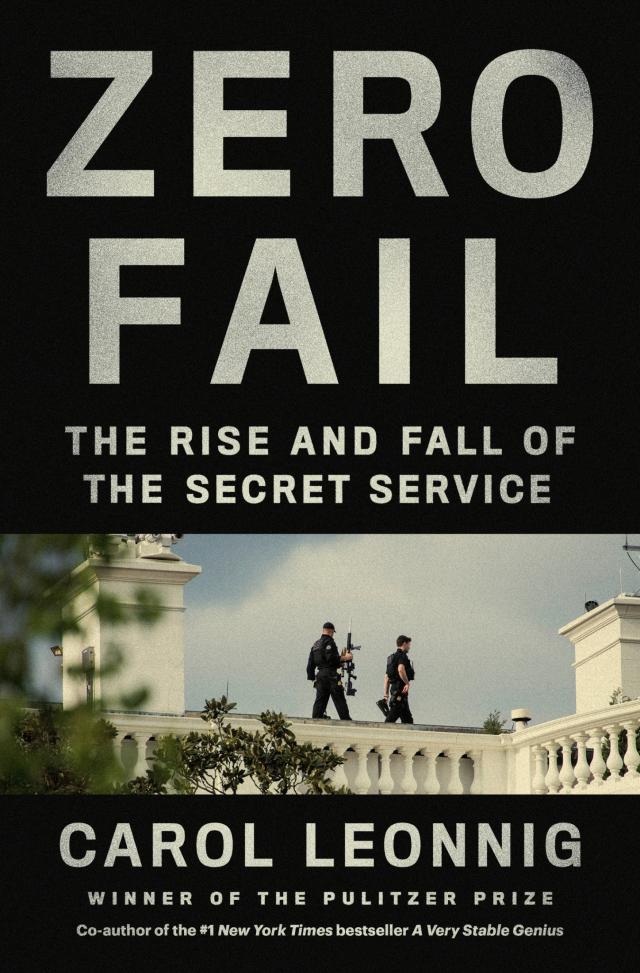
Cover photo: Jabin Botsford/The Washington Post via Getty Images
ep_prh_5.7.0_140201715_c0_r7
Contents
Cover
Title Page
Copyright
Author’s Note
Prologue
Part 1: The Tragedy That Birthed a New Secret Service: Kennedy to Nixon (1963-1974)
Chapter 1: Protecting Lancer
Chapter 2: Tempting the Devil
Chapter 3: Three Shots in Dallas
Chapter 4: No Time to Grieve
Chapter 5: One Last Day on the Trail
Chapter 6: The President’s Spies
Part 2: Meeting the Test: Ford to Clinton (1974–1999)
Chapter 7: A Casual Walk to Church
Chapter 8: Battening Down the Hatches
Chapter 9: Night of the Long Knives
Chapter 10: A Happy Service, a Rising Threat
Chapter 11: A Rock Star President
Chapter 12: The Intern
Part 3: Terror and Politics: The Bush Years (2000–2007)
Chapter 13: Scrambling on 9/11
Chapter 14: “You Don’t Belong Here”
Chapter 15: “He Predicted All of It”
Part 4: The Wheels Come Off: The Obama Years (2008–2015)
Chapter 16: “He’ll Be Shot Sure as Hell”
Chapter 17: Sullivan’s Crew
Chapter 18: The Night Bullets Hit the White House
Chapter 19: “I Woke Up to a Nightmare”
Chapter 20: Sullivan’s Struggles
Chapter 21: Outed
Chapter 22: A New Sheriff in Town
Chapter 23: A Listing Ship
Chapter 24: “He’s in the House”
Part 5: Sliding Backward: The Trump Years (2016–2021)
Chapter 25: Clancy’s Turn
Chapter 26: Chaos Candidate
Chapter 27: Taking a Hit for Trump
Epilogue
Dedication
Acknowledgments
Notes
By Carol Leonnig
About the Author
AUTHOR’S NOTE
When I began reporting on the United States Secret Service in 2012, this unique law enforcement agency was rocked by what seemed like the most humiliating scandal in its modern history: A dozen agents and officers stood accused of turning a presidential trip to a South American resort town into a kind of Vegas bachelor party, complete with heavy drinking and prostitutes. At the time, the misconduct shocked the country precisely because the men and women of the Secret Service had for so long been synonymous with tireless and selfless vigilance, a band of patriots willing to take a bullet to protect America’s democracy.
But as I reported more deeply, I learned of a more worrisome scandal than these Mad Men–style antics: This long-revered agency was not living up to its most solemn duty—to keep the president safe. Agents and officers gave me a guided tour, showing me step by step how the Secret Service was becoming a paper tiger, weakened by arrogant, insular leadership, promotions based on loyalty rather than capability, years of slim budgets, and outdated technology. With their help, I decided to dig deeper still to understand how this had happened and to chart the previous five decades of the proud Secret Service. How had it recovered from the assassination of President Kennedy, rebuilt its security force to be the envy of the world, and later begun a slow slide that had worried and angered its frontline workers?
An important note about my purpose: Some Secret Service leaders and alumni have vowed to attack my work, claiming that I seek to embarrass their venerable institution and highlight its blemishes. But it is for the Secret Service’s front line and its future that I write these hard truths. I am in awe of the agents and officers who pull together for their critical common purpose, and what they still accomplish every day under considerable strain. They toil on, often without thanks, proper support, or a proactive strategy from above. I write because they deserve better.
This book is based on hundreds of hours of interviews with more than 180 people, including current and former Secret Service agents, officers, and directors, cabinet members, advisers, and senior government officials in eight previous presidential administrations, and members of Congress and their staff, as well as other witnesses to the events described herein. I spoke with Secret Service staff who worked a heartbeat from the president and in far-flung field offices, and with the equally dedicated members of their families. Most of the people who cooperated in my research agreed to speak candidly on condition of anonymity, either to protect their careers or because they feared retaliation from the agency and alumni who seek to tamp down bad news and burnish the agency’s brand. Many shared their experiences in a background capacity, allowing me to use their information as long as I protected their identities and did not attribute details to them by name.
I am an objective journalist dedicated to sharing the truth with the public, and here I have aimed to provide an account that is as close to the full truth as I could determine based on rigorous reporting. Scenes you read in this book are reconstructed from firsthand accounts and, whenever possible, corroborated by multiple sources. They are also vetted by my review of internal government reports and memos. While there is a tendency to discount the words of anonymous sources, many of the people who spoke to me in confidence also submitted to rigorous fact checking and shared with me contemporaneous notes, calendars, and correspondence to buttress their accounts. Dialogue cannot always be exact, but it is based here on multiple people’s memories of events. In a few instances, different sources disagreed about substantive elements, and when necessary, I note that, acknowledging that different narrators can remember events differently.
This book is an outgrowth of my reporting for The Washington Post. Some of the episodes you read in Zero Fail began with stories I wrote for the newspaper, often with the help of my wise colleagues. The majority of the scenes, dialogue, and quotations are original to my book, however, and based on the extensive reporting I conducted exclusively for this project.
This historical account benefited significantly from contemporaneous news reports in The Washington Post and other publications. I also relied on a handful of compelling books covering specific periods, including some written by former agents who recognized that their experiences are indeed the stuff of history. I credit key information gleaned from those accounts, either with a direct reference in the narrative or in the endnotes.
PROLOGUE
On the evening of March 30, 1981, an eight-year-old boy in Norfolk, Virginia, sat glued to his family’s living room TV. Earlier that day, John Hinckley, Jr., had attempted to assassinate Ronald Reagan outside the Washington Hilton. But as CBS News played the scene in a slow-motion loop, the boy’s focus wasn’t on the president. It was on the man who entered the frame.
Over and over again, the boy watched in amazement as this square-jawed man in a light gray suit turned toward the gunfire and fell to the ground, clutching his stomach. By taking a bullet for the president, the newsman said, Tim McCarthy probably saved his life. At that moment, young Brad Gable (not his real name) knew exactly what he wanted to do when he grew up:
He would be a Secret Service agent.
Now, thirty years later, Gable had indeed fulfilled that mission. He was a member of the Secret Service’s Counter Assault Team, or CAT. In the constellation of presidential protection, CAT arguably has the most dangerous assignment. When most people think of the Secret Service, they picture the suited agents who cover and evacuate the president in moments of danger. The heavily armed CAT force has a different mission: Run toward whatever gunfire or explosion threatens the president and neutralize it. The team’s credo reflects the only two fates they believe
Gable was proud of the career he had chosen. Among his colleagues, he was respected for the pure patriotism driving him and for his intense focus on operational details. So why, in the late summer of 2012, as he sat in a restaurant near Fort Bragg, North Carolina, did he suddenly feel like throwing up?
Gable and his fellow agents had come to a mom-and-pop restaurant with a group of Delta Force members who were overseeing the CAT team’s annual training. Gable’s squad had drilled for almost a week with these steely Special Forces operators, playing out mock assassination attempts and blind attacks to learn how to shield themselves and their buddies in close-quarters combat.
After a dinner of ribs, steaks, and wings, Gable sat back for some beers and small talk with one of 9/11’s faceless heroes, a Delta Force sergeant major I’ll call John. Gable liked John’s no-bullshit style. He had real battlefield experience—two weeks after the 9/11 attacks, he’d been part of the raid on Mullah Omar’s Kandahar compound, but he didn’t crow about it—which instantly earned Gable’s trust and respect.
On his second beer, Gable felt loose enough to ask John a question that had been on his mind: “After teaching so many operators and law enforcement agents, what do you think of the Secret Service’s overall readiness?” The sergeant major demurred, so Gable pressed him.
“Seriously, how would you rate us?”
“Look,” John said. “I feel sorry for you guys. The Service has really let you down. You’ll never be able to stop a real attack.”
It wasn’t the answer Gable had hoped for, and as he listened to John dissect the Service’s outdated equipment and spotty training, his stomach grew queasy. Deep down, he knew how ill-equipped and out of date the Secret Service was, but hearing it articulated by someone he respected made it impossible to deny. His mind drifted to all the times he had seen the Service drop the ball—most recently, a 2010 trip to Mumbai with President Obama, in which his unit had narrowly avoided a major international incident after nearly killing an unidentified gunman who turned out to be a local police officer. Scenarios like these were dress rehearsals for a real attack on the president, and in his five years with CAT, he had seen the Service fail so many of them.
Gable was now faced with a brutal truth: Increasingly, the Secret Service was fulfilling its Zero Fail mission based not on its skills, people, training, or technology, but on dumb luck. How long would it be before that luck ran out? Gable wasn’t alone. He knew other dedicated agents who felt a growing sense of disillusionment, especially with the agency’s leadership. But fear of repercussions had kept them silent. Until the stakes got too high.
* * *
—
I’VE BEEN COVERING the Secret Service since 2012, starting with my reporting on “Hookergate,” the scandal in which agents brought prostitutes to their hotel rooms while making arrangements for President Obama’s visit to Cartagena, Colombia—and which gave me my first glimpse into the Service’s deeper institutional problems. In the years since, however, many agents have expressed concerns to me about the agency’s ability to guard the presidents, their families, and other key government officials. They describe an organization stretched too thin, drowning in new missions, and fraught with security risks brought on by a fundamental mistrust between rank-and-file agents and leadership.
These agents have rejected the Service’s code of silence in favor of the higher good of sounding an alarm. They came to me hoping that an investigative reporter at The Washington Post could bring attention to their concerns, shame the leaders who had failed them, and help right the ship. To tell their complete story, I conducted and reviewed hundreds of interviews with agents, officers, directors, lawmakers, presidents, and their staffs. I read through thousands of documents, including presidential archives as well as internal Secret Service reports, investigation files, and security reviews that have never been shared publicly. What I discovered was a rich, complicated story—of bravery and venality, heroism and incompetence—that America cannot and should not turn away from.
This book isn’t an academic history. My intent here is to focus on the rise and entirely avoidable fall of the Secret Service over the last sixty years, from Kennedy to Trump. We sometimes forget that this proud, largely invisible force stands between the president and all attackers. By protecting the president, they protect democracy. And while the agency once stood for dedication and perfection in the face of impossible odds, it now finds itself in a state of unprecedented peril.
In these pages, I attempt to paint the portrait of an agency marked by a unique set of contradictions: An ever-shifting and murky mission coupled with impossible expectations to meet it. A rigid management structure that inspires discipline while also inciting resentment and rebellion. An organization whose performance standards are far higher—and whose morale and personal conduct standards are, at times, far lower—than those of any other federal agency. A working battalion whose members often sacrifice a normal life and push themselves to exhaustion to deliver on a near-impossible mission, slaving for some leaders who look after themselves first and fail to make the bold choices that could help support their corps.
My goal is to offer a behind-the-scenes look at an organization saddled with a never-ending struggle to improve its reputation, boost its resources, and raise its morale. In perhaps the ultimate irony, I present an agency that seems to improve only in the wake of the thing it is sworn to prevent: tragedy.
In the last six decades, the Secret Service has grown from three hundred agents and a $5 million budget to seven thousand agents, officers, and other staff and a budget of over $2.2 billion. Its mission has expanded as well. Instead of protecting one leader, the agency now shields his extended family, many of his deputies, and even his political opponents. It focuses not just on stopping a bullet but also on blocking a drone carrying poison gas, a cyberattack throttling the nation’s energy grid, and any threat to a stadium of spectators watching the Super Bowl. This kind of mission growth could prove challenging to any organization. But the Service hasn’t just suffered growing pains. By its own staff’s measures, the agency’s standards and capacity to fulfill its core assignment have been slipping for years, raising several crucial questions:
How did the Secret Service go from an elite, hardworking band of patriots vowing to do whatever it takes to protect future presidents in the wake of JFK’s assassination, to a frat boy culture of infighting, indulgence, and obsolescence?
How did the Service go from a close-knit group that prided itself on a nonpartisan “the people elect ’em, we protect ’em” attitude, to an organization that is used by presidents for craven political means and feels it must acquiesce to stay in favor?
And finally, how did the Service go from an institution that inspired and captured the imagination of an eight-year-old boy in Norfolk, Virginia, to an organization that can’t hire people fast enough to fill its departures, and that for three years running had recently been ranked as the most hated place to work in the federal government?
Zero Fail chronicles this deterioration across decades, leadership changes, and game-changing world events. But while the agency has suffered many embarrassing failures along the way, it must be noted that no president has been killed on its watch since John F. Kennedy. Many committed men and women who stand on rope lines and scour crowds looking for the subtlest signs of danger have been tested repeatedly, and at least by their own sense of duty, they have proved themselves true to their motto: “Worthy of Trust and Confidence.” Sadly, their organization can’t stop an assassin with stubborn devotion alone.
Writing this book helped me see how the Service’s decline has been decades in the making, but it also helped me appreciate the many agents who keep their rounds despite the disorder and haphazard management swirling around them. Every day, these public servants, whom Eisenhower dubbed “soldiers out of uniform,” brave cold and wet at the White House gates and endure mind-numbing boredom guarding convention center stairwells and hotel hallways. They sweat through their undershirts and socks standing for hours at back-to-back campaign rallies. They maintain for hours, for days, the kind of hypervigilance that would exhaust a normal person after just ten minutes.






