The message, p.1
The Message, page 1
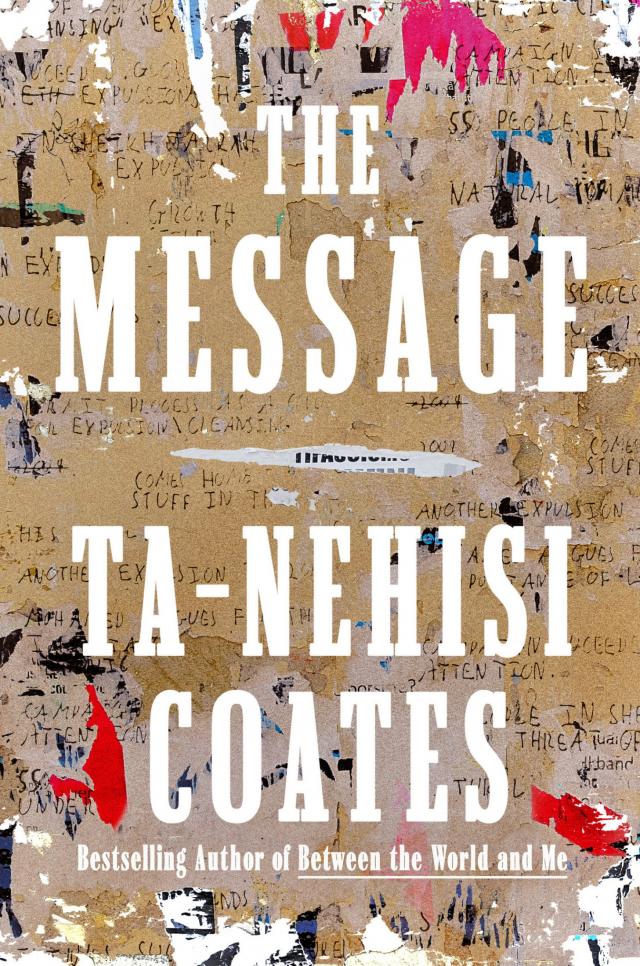


By Ta-Nehisi Coates
The Beautiful Struggle
Between the World and Me
We Were Eight Years in Power
The Water Dancer
The Message
Copyright © 2024 by BCP Literary, Inc.
Penguin Random House values and supports copyright. Copyright fuels creativity, encourages diverse voices, promotes free speech, and creates a vibrant culture. Thank you for buying an authorized edition of this book and for complying with copyright laws by not reproducing, scanning, or distributing any part of it in any form without permission. You are supporting writers and allowing Penguin Random House to continue to publish books for every reader. Please note that no part of this book may be used or reproduced in any manner for the purpose of training artificial intelligence technologies or systems.
All rights reserved.
Published in the United States by One World, an imprint of Random House, a division of Penguin Random House LLC, New York.
One World and colophon are registered trademarks of Penguin Random House LLC.
Grateful acknowledgement is made to Beacon Press for permission to reprint three stanzas from “Rebirth” from Collected Poems by Sonia Sanchez, copyright © 2022 by Sonia Sanchez. Reprinted with permission from Beacon Press, Boston, Massachusetts.
Library of Congress Cataloging-in-Publication Data
Names: Coates, Ta-Nehisi, author.
Title: The message / by Ta-Nehisi Coates.
Description: First edition. | New York, NY: One World, [2024]
Identifiers: LCCN 2024034056 (print) | LCCN 2024034057 (ebook) | ISBN 9780593230381 (hardcover) | ISBN 9780593230398 (ebook)
Subjects: LCSH: Coates, Ta-Nehisi. | Coates, Ta-Nehisi—Travel. | African American journalists—Biography. | Senegal—Social conditions. | South Carolina—Race relations. | Israel—Ethnic relations. | Journalists—United States—Biography.
Classification: LCC PN4874.C598 A3 2024 (print) | LCC PN4874.C598 (ebook) | DDC 070.92 [B]—dc23/eng/20240827
LC record available at lccn.loc.gov/2024034056
LC ebook record available at lccn.loc.gov/2024034057
ISBN 9780593230381
Ebook ISBN 9780593230398
oneworldlit.com
randomhousebooks.com
Book design by Caroline Cunningham, adapted for ebook
Cover design: Michael Morris
Cover images: Busà Photography/Getty Images (wall); Travelstoxphoto/Getty Images (texture); Handwriting by the author
ep_prh_7.0_148387781_c0_r1
Contents
Dedication
Epigraph
Part I: Journalism Is Not a Luxury
Part II: On Pharaohs
Part III: Bearing the Flaming Cross
Part IV: The Gigantic Dream
Notes on Sources
About the Author
_148387781_
For my sons, Samori and Chris
In a peaceful age I might have written ornate or merely descriptive books, and might have remained almost unaware of my political loyalties. As it is I have been forced into becoming a sort of pamphleteer.
George Orwell, “Why I Write”
I.
Journalism Is Not a Luxury
Though we do not wholly believe it yet, the interior life is a real life, and the intangible dreams of people have a tangible effect on the world.
—James Baldwin
Comrades,
In the summer of 2022, I returned to Howard University to teach writing. Given my rather middling career as a university student, I couldn’t help but feel somewhat sheepish about the honor. But it was an honor, because it was there that I met you. Our first class was in the woods—out in rural Virginia, where, with my friend the poet Eve Ewing, we spent two weeks reading, writing, and workshopping. I’ve been teaching writing in some form or capacity for almost as long as I’ve been a writer, and the only work I love more is writing itself. But with you I found the former rivaling the latter. I don’t mean to slight any other cohort of students I’ve taught in other times and places—all were talented and hardworking. But the fact is, we were drawn together by something more profound.
I guess it begins with our institution, and the fact that it was founded to combat the long shadow of slavery—a shadow that we understood had not yet retreated. This meant that we could never practice writing solely for the craft itself, but must necessarily believe our practice to be in service of that larger emancipatory mandate. This was often alluded to, if not directly stated. All of our work dealt with the kind of small particulars of being human that literature generally deals with. But when you live as we have, among a people whose humanity is ever in doubt, even the small and particular—especially the small and particular—becomes political. For you there can be no real distance between writing and politics. And when I saw that in you, I saw myself.
A love of language, of course, is the root of this self. When I was barely six months old, I would crawl over to my father’s speakers when he played the Last Poets. And when the record ended, I would cry until he played it again. At five I would lie on my bed, with the Poems and Rhymes volume of the Childcraft series splayed open to “The Duel,” and all day I could not help but to murmur to myself, “The gingham dog and the calico cat / Side by side on the table sat.” I did this for no other reason than the way the words felt in my mouth and fell on my ears. Later I discovered that there were MCs—human beings seemingly born and reared for the sole purpose of matching the music of language to an MPC snare or 808 kick—and the ensuing alchemy felt as natural to me as a heartbeat:
I haunt if you want, the style I possess
I bless the child, the earth, the gods and bomb the rest
Haunt. You’ve heard me say this word a lot. It is never enough for the reader of your words to be convinced. The goal is to haunt—to have them think about your words before bed, see them manifest in their dreams, tell their partner about them the next morning, to have them grab random people on the street, shake them and say, “Have you read this yet?” That was what I felt whenever I heard Rakim spit, or for that matter the Last Poets. That was the thing that had me murmuring lines from Childcraft. This affliction was enchantment and desire. It was pleasure but also a deep need to understand the mechanics of that pleasure, the math and color behind words, and all the emotions they evoked. I imagine there are children who see a painting and cannot get the image out of their minds. I imagine they turn it over alone at night in the dark, haunted, considering and reconsidering, and a small secret ecstasy grows in them each time they do this, and, just behind this, a need to convey an ecstasy all their own. I was like that from the moment I could inscribe words into memory. And this instinct naturally linked to the world around me, because I lived in a house overflowing with language organized into books, most of them concerned with “the community,” as my mother would put it. And so it was made clear to me that words could haunt not only in form, not only in their rhythm and roundness, but in their content.
When I was seven years old, my mother purchased a copy of Sports Illustrated for me. She taught me to read before I entered school, and encouraged the practice however she could. And what more encouragement could there be than this issue of Sports Illustrated, which featured my hero, Tony Dorsett, running back for the Dallas Cowboys. This was 1983, an era of American football when running backs seemed as large as champions pulled out of Greek myth. How could a man of Earl Campbell’s might move so fast, racing past one defender and then staving in the chest of another? How could Eric Dickerson run so high, against all convention, bounding through holes in the defense, an obvious target that was never caught? These days I will occasionally watch an old clip of Roger Craig, through will alone, breaking off a forty-six-yard run against the Rams, or Marcus Allen reversing field in the Super Bowl. But back then, in an unwired world, stories, words, histories—none of it could be gotten on demand. If you bore witness to such a feat—as I did with Allen—it lived in memory until the broadcast gods decided you could see it again. And so a magazine featuring the exploits of one of these heroes was not just, to me, an assembly of words and stories. It was a treasure.
Because I really did believe that Tony Dorsett was magic. He was five foot eight, built ordinary as one of my uncles. But when he slid the lone-starred helmet over his head, he transformed into something untouchable. I remember him darting through the defense, shifting direction at full speed, dancing, sprinting the length of the field, and outrunning an entire team. But whatever my affinity for Dorsett, this is not what I remember about that issue. In fact, until a few months ago, I’d forgotten that Dorsett was even on the cover at all, because deeper in the magazine, I found a story so unsettling, so horrific even, that it blotted out every adjacent detail.
The story was titled “Where Am I? It Has to Be a Bad Dream.” Its subject was Darryl Stingley, who’d once been a wide receiver. I thought of wide receivers as mythical too—contortionists like Wes Chandler, extending back to snag a ball bouncing off into the ether, or acrobats like Lynn Swann, dancing in the air. I absorbed these exploits on Sunday mornings through highlights curated by the NFL itself. But a magazine like Sports Illustrated existed beyond the garden, out in the street where journalism and literature collided. And out there was neither magic nor myth—only the reale
And so I read the true story of Stingley, who back in 1978 took a hit on a slant route and woke up in a hospital. The story began there, in the hospital—with Stingley unable to move a single limb, unable to call to his mother or wipe the tears running down his face. In an instant, the contortionist had been rendered quadriplegic. Only a few paragraphs in, I wanted to put the magazine down forever, to escape the story, but I was held fast by forces I could not then understand. I knew that there was something different in the storytelling, something in its style, that pulled me toward it with the gravity of a star, until I was there, I was on the field, yelling, pleading with Stingley to watch out for the incoming hit, and then in the hospital, right next to him, helpless to relieve the horror blooming in his eyes as he realized his fate. And then the star became a black hole, and I crossed an event horizon where I was no longer imagining myself there with Stingley, but was Stingley himself, and it was my body pinned to the bed, and the spokes were drilled into my skull, and it was I crying out to a heedless god.
I haunt if you want, the style I possess. And I was haunted—by a style, by language. And, dimly, instinctually, I understood that the only exorcism lay in more words. I went to my father and bombarded him with questions, because that was the kind of child I was, always (to the annoyance of my siblings) asking why. My father’s way of dealing with this was patented and that day he executed the maneuver to perfection. He led me to the back room, where he kept a large collection of books, and pulled one down from the shelf. The book was They Call Me Assassin. It was the memoir of Jack Tatum—the defensive back who’d laid the crushing hit on Stingley.
And so I delved deeper—hoping for some insight into the mindset of a man who had permanently crippled another. I’d like to tell you I found some great revelation here, but the book was mostly filled with stories of Tatum’s only vaguely interesting football career. I recall Tatum writing that the hit on Stingley was unremarkable in its violence. If a reader came, as I did, looking for some profound meditation on a catastrophe, it was not to be found. And so I was left again to grapple on my own—no Google, no Wikipedia, no social network through which to commiserate with others. Just me and this terrible story of an acrobat entombed in his own body playing over and over in the back of my mind.
But something had happened to me in this process. As a reader, I changed. I was no longer merely turning words over in my head or on my tongue—I was now turning over entire stories. Even Tatum’s story spoke volumes by not speaking much at all, for it nodded to the shame one might feel or the paradox of a game that valorizes violence and then is horrified by its consequences. I did not yet see all of that. But for years after, as I turned the stories over in my mind, I could feel the revelations spinning out of them. What I felt then was that the story of Darryl Stingley broke some profound invisible law of justice, one that reigned in all my cartoons. I knew football was violent—it was the violence that backlit Tony Dorsett’s escape act. But violence was the antagonist in a story with a happy ending. It could never win, could it?
But all around me violence actually was winning. That was the year when I first remember a child being shot over a trendy article of clothing; stories like that would soon become the background of my adolescence. And now danger swirled all around me—tales of razors slipped into candy apples, four-year-olds impaled with lawn darts. Stingley’s story pulled all this together and illuminated a new idea: Evil did win, sometimes—maybe most times. Bad things did happen, if only for the simple reason that they could. Disturbing as this knowledge was, it made me stronger because it made me wiser. And the weight of this wisdom was intimately associated with the method of its delivery. Journalism. Personal narrative. Testimony. Stories.
I grew older. Bad things began to happen to me and the people around me: beatdowns, bankings, tool poppings, jewel runnings. I think the only way I ultimately survived was through stories. Because as much as stories could explain my world, they could also allow me to escape into others. And so whatever was outside, I could come back home to the World Book Encyclopedia and let words transport me to forests and jungles, taiga and tundra. Or I could pick up a copy of Deadly Bugs and Killer Insects and, through words, take pleasure in the lethal biology of black widows and fire ants. Or I could open up African Glory and cross the Sahara with Mansa Musa or see the realm of Songhai through Askia the Great. Or I could come back to my world, through LP or tape, through “Louder Than a Bomb,” “The Symphony,” or “My Philosophy.” None of these worlds were separate in my mind. I did not have then, and do not have now, a real sense of “high” or “low” art. All I cared about was what haunted me and why—and slowly I began to see the thread running through each of them. In high school, I read Macbeth and found myself as far beyond the classroom as any Kool G Rap verse could take me:
Second Murderer
I am one, my liege,
Whom the vile blows and buffets of the world
Hath so incens’d, that I am reckless what I do
To spite the world.
First Murderer
And I another,
So weary with disasters, tugg’d with fortune,
That I would set my life on any chance,
To mend it, or be rid on ’t.
What I saw here was my city, which was connected to other cities whose mores and codes were then being rhapsodized in mixtapes and music videos—Gods and Earths, Gangstas and Queens. But here was another dead star, with another gravity, pulling me across centuries, until I saw that even there the rules and mores, which I had taken to be ours alone, still held. And through words I understood that my Baltimore was not damned, that what I saw in the eyes of the boys there, what I heard in the music, was in fact something old, something ineffable, which marked all of humanity, stretching from Stratford upon Avon to the Streets.
And always at these moments I was taken back to the obsessions of my childhood: the organization of words, silences, and sound into stories. And to that I added the employment of particular verbs, the playful placement of punctuation, and the private ecstasy it all brought to me. And I saw, considering the phrase “I am one, my liege, / Whom the vile blows and buffets of the world,” that there was magic in Shakespeare’s repetition of a sound represented in the b, and that this was the same magic used by Rakim, only this time with the sound represented by the r:
I’m the arsenal, I got artillery, lyrics are ammo
Rounds of rhythm, then I’ma give ’em piano
I was about your age when I began to understand what I had first glimpsed in that copy of Sports Illustrated—that sound and rhythm are even more powerful when organized into narrative. That is to say, words are powerful, but more so when organized to tell stories. And stories, because of their power, demanded rigorous reading, interpretation, and investigation. There I was, the Sports Illustrated spread in my lap, feeling launched on a voyage of discovery. I finished the article but needed to know more. So I sought to report, and thus turned my own father into my first source. That source then sent me to the library to research. And there, frustratingly, the journey ended. Books could take me only so far. If only I could have talked to Tatum or Stingley myself. If only I could be the one crafting the questions and organizing and interpreting the answers and then, with words, expressing the meaning I extracted from the quest.
As it happened, I could. At Howard, I found a sprawling library beyond the single room of my father. There were databases filled with articles from magazines and newspapers. And I was an adult now, and I could, as it turned out, call people and question them myself, so that the ranks of potential sources now increased. Armed with those raw sources and my own sense of how words might be organized—a style I possessed—maybe I could go from the haunted to the ghost, from reader to writer, and I too could have the stars, and their undeniable gravity, at my disposal.