Zero gravity, p.1
Zero Gravity, page 1


Copyright © 2022 by Woody Allen
Foreword copyright © 2022 by Daphne Merkin
All rights reserved. No part of this book may be reproduced in any manner without the express written consent of the publisher, except in the case of brief excerpts in critical reviews or articles. All inquiries should be addressed to Arcade Publishing, 307 West 36th Street, 11th Floor, New York, NY 10018.
First Edition
Arcade Publishing books may be purchased in bulk at special discounts for sales promotion, corporate gifts, fund-raising, or educational purposes. Special editions can also be created to specifications. For details, contact the Special Sales Department, Arcade Publishing, 307 West 36th Street, 11th Floor, New York, NY 10018 or arcade@skyhorsepublishing.com.
Arcade Publishing® is a registered trademark of Skyhorse Publishing, Inc.®, a Delaware corporation.
Visit our website at www.arcadepub.com.
10 9 8 7 6 5 4 3 2 1
Library of Congress Cataloging-in-Publication Data is available on file.
Library of Congress Control Number: 2022933864
Cover design by Brian Peterson
ISBN: 978-1-956763-29-4
Ebook ISBN: 978-1-956763-34-8
Printed in the United States of America
To Manzie and Bechet, our two lovely daughters who have grown up before our eyes and used our credit cards behind our backs.
And of course Soon-Yi—if Bram Stoker had known you he’d have had his sequel.
Contents
Foreword by Daphne Merkin
Acknowledgments
You Can’t Go Home Again—And Here’s Why
Udder Madness
Park Avenue, High Floor, Must Sell—Or Jump
Buffalo Wings, Woncha Come Out Tonight
Will the Real Avatar Please Stand Up
A Little Face Work Never Hurt
Tails of Manhattan
Wake Me When It’s Over
Now Where Did I Leave That Oxygen Tank?
Flap in the Dynasty
Not a Creature Was Stirring
Think Hard, It’ll Come Back to You
Sorry, No Pets Allowed
Money Can Buy Happiness—As If
When Your Hood Ornament Is Nietzsche
Over, Around, and Through, Your Highness
There Is Nothing Like a Brain
Rembrandt by a Nose
Growing Up in Manhattan
Foreword
by Daphne Merkin
IT’S NO EASY matter being funny. As anyone knows who’s stood around a cocktail party listening to someone’s lame jokes and having to laugh pallidly but politely in response, the wish to be funny looms large but is rarely granted. Being funny on the page, where timing and gestures and facial expressions can’t be leaned on to punctuate or add emphasis to a quip, may be even more difficult. Once, in a time that seems far away, the art of being funny, of writing the sort of comic pieces that The New Yorker referred to as “casuals,” was practiced by such fleet-fingered greats as Robert Benchley, Dorothy Parker, George S. Kaufman, and S. J. Perelman. These days being funny, especially in print, seems, for the most part, to be a sweatier, more labored enterprise—producing smiles of recognition, perhaps, but hardly chuckles or outright yelps of laughter.
And then there’s Woody Allen. Many of his witticisms, whether from his essays or films, are embedded in our culture: “If it turns out that there is a God … the worst thing you can say about him is that he’s basically an underachiever” [Love and Death]. Others are less familiar but equally memorable, their effect based on an unexpected linkage of high-brow allusions and low-brow humor: “I worked with Freud in Vienna. We broke over the concept of penis envy. Freud felt that it should be limited to women” [Zelig]. One of my favorite lines is a send-up of the kind of portentous memoirist who assumes everyone is interested in his revelations and thus irritatingly tries to cover his tracks. The line comes from “Selections from the Allen Notebooks,” the first piece in Without Feathers, his second collection, published in 1975. (The first was Getting Even, published in 1971.) ”Should I marry W.? Not if she won’t tell me the other letters in her name.” A third collection, Side Effects, was published in 1980, and a fourth, Mere Anarchy, appeared in 2007.
There is also the fun made of Emily Dickinson’s genteel observation, which functions as the epigraph of Without Feathers (“Hope is the thing with feathers”), which Allen painstakingly and hilariously corrects: “How wrong Emily Dickinson was. Hope is not ‘the thing with feathers.’ The thing with feathers has turned out to be my nephew. I must take him to a specialist in Zurich.” Not to overlook the opening of “Examining Psychic Phenomena”: “There is no question that there is an unseen world. The problem is, how far is it from midtown and how late is it open?” Perhaps the most priceless piece in the book is “The Whore of Mensa,” about an eighteen-year-old Vassar student who doubles as a call girl. The madam she works for has a master’s in comparative literature, and the eighteen-year-old’s specialty is engaging clients in intellectual discourse. She can rattle on about Moby Dick (“Symbolism’s extra”) and the lack of “the substructure of pessimism” in Paradise Lost. The piece is nothing short of ingenious—and side-splitting.
But one could go on and on. Without Feathers was published, hard as it is to believe, nearly half a century ago and spent four months on the New York Times bestseller list. It cemented Allen’s reputation as a cerebral jokester, an extension of the hapless, meek persona in his films but with an almost imperceptible shift away from his self-effacing nebbishyness to a figure with slightly (just slightly) more authority to comment on the preposterous world around him. There remained the characteristic undertone of melancholia—what Allen himself has referred to as anhedonia (the inability to enjoy things)—and the urban point of view, as well as the pessimistic outlook that partakes of the absurd and colors everything he lays eyes on, from love, sex, and death to the monuments of culture. In a section called “Prognostication,” again in “Examining Psychic Phenomena,” he quotes the ostensibly wise sayings of a sixteenth-century count called Aristonidis. “I see a great person,” this sage declaims, “who one day will invent for mankind a garment to be worn over his trousers for protection while cooking. It will be called an ’abron’ or ‘aprone.’ {Aristonidis meant the apron, of course.)”
If comedians, as well as thirteen-year-old Asian pianists, can be said to be prodigies, then Allen certainly qualifies as one. He began selling jokes at fifteen and was bounced out of NYU because he played hooky a lot and didn’t work or pay attention. A scant few years later, Allen was writing scripts for Sid Caesar specials, producing jokes at a rapid-fire pace. He worked with Mel Brooks, Larry Gelbart, Carl Reiner, and Neil Simon and could sit at his typewriter, as legend had it, for fifteen hours at a time, punching out wisecracks and witticisms. (No writer’s block here.) He went on during the sixties to perform as a standup comedian around Greenwich Village, at The Bitter End and Cafe Au Go Go. He also was writing and directing slapstick comedies, such as Take the Money and Run (1969), Bananas (1971), Sleeper (1973), and Love and Death (1975). I can still remember watching Take the Money and Run as a resistant, try-and-make-me-laugh adolescent and breaking into loud giggles when Allen, playing a foiled bank robber, holds up a sign saying, “I have a gub.”
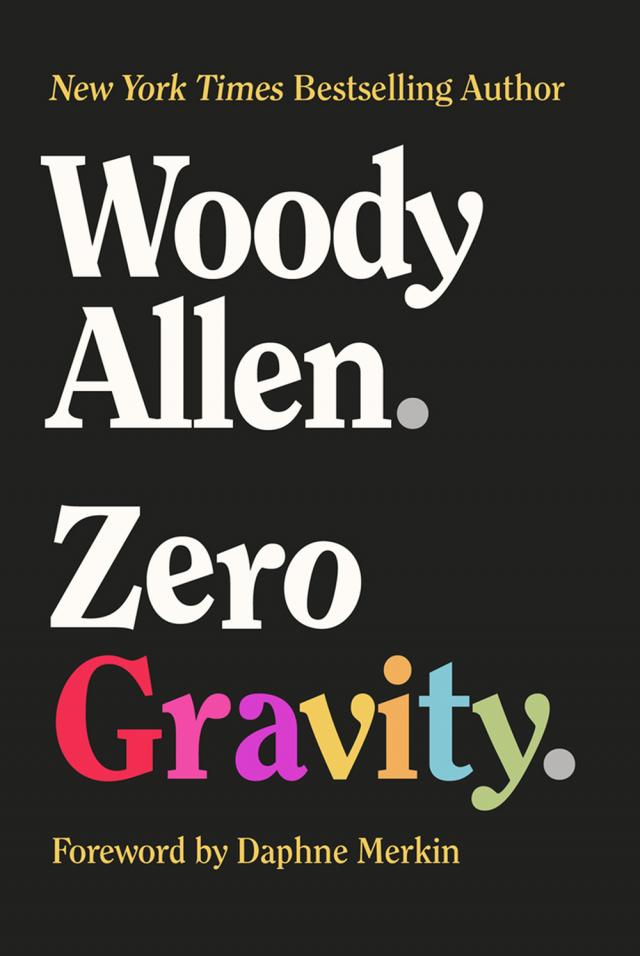
And now, ladies and gentlemen and non-binary members of the reading public, your patience has been rewarded. The sad-eyed auteur has returned more than fifteen years since his last collection with a new volume called Zero Gravity. Some of the pieces have appeared in The New Yorker, and others have been written expressly for this volume. The latter include a poignant, fifty-page short story called “Growing Up in Manhattan,” which is quintessentially Allenesque in its mixture of romantic wistfulness and a raised-eyebrow air of disbelief at yet another contradiction in “a world especially designed for him never to figure out.”
Allen’s stand-in is twenty-two-year-old Jerry Sachs, who has grown up in Flatbush in “a red-brick apartment building named after a patriot. The Ethan Allen. He thought a better name for the place given its grimy exterior, drab lobby, and drunken super, would be the Benedict Arnold.” Sachs works in the mailroom of a theatrical agency, despite the wish of his mother, “a perpetually charmless woman,” that he become a pharmacist. The most revered member of his family is a cousin who “enunciated like Abba Eban.” Sachs lives in “a crammed single-room walk-up on Thompson Street” and annoys his wife Gladys (a perfect name for a first wife), who works at a real-estate office and attends City College at night to become a teacher, with his “smorgasbord of psychosomatic complaints.” He is enamored of Manhattan at its most glamorous, during the days of El Morocco and Gino’s, when “beautiful people” exchanged “bright dialogue” and sipped cocktails “on a Cedric Gibbons set.”
One spring day, he is sitting on his favorite bench on the west side of the sailboat pond when a lovely young girl named Lulu, with violet eyes that “projected city smarts,” sits down on the other end of the bench. When he tells her he’s writing a play “about a Jewish woman forced to make existential choices,” Lulu chimes in that she did her thesis on German philosophy. “The Concept of Freedom in the Poetry of Rilke.” She is thrilled with the notion of Sachs giving a comic treatment to these themes, and he reacts accordingly: “Her approbation caused the top of his head to dislodge, lift off like a flying saucer, and tour the solar system before returning.” And from there, at least for a while, the two engage in kismet—until such moment as the relationship goes downhill, havin
There are eighteen other, shorter pieces that tackle everything from aspiring, deadbeat actors who have agents like Toby Munt of Associated Parasites to the origins of General Tso’s Chicken to the pied-à-terre cum “huge mansion in Belgravia” where the Duke and Duchess of Windsor reside, with the Duke worrying about how to create a passable Windsor knot and the best way to make a bowtie while the Dutchess, “trying to busy herself, is practicing the Watusi from a dance diagram laid on the floor.” One essay, “Park Avenue, High Floor, Must Sell—Or Jump,” portrays the avarice and wheeling-dealing of the real-estate market, and another depicts a horse who dabbles in oils and becomes a sought-after artist. “Tails of Manhattan” brings us Abe Moskowitz, who “dropped dead of a heart attack and was reincarnated as a lobster,” after which the story glides into a spoof on the arch-schemer Bernie Madoff, who just misses being turned into a lobster himself. One piece, “Money Can Buy Happiness—As If,” turns Monopoly into a real-life game played for high stakes by former partners at Lehman Brothers. Another takes on a bunch of recalcitrant chickens, while yet another debates the virtue of various pillows, which conversation is set in the London Explorers Club. There’s a quick, sly stab at woke culture, and of course Hollywood, with its faux glitz and pseudo hierarchies, comes in for frequent drubbings.
Here’s the clincher: Allen has lost not one whit of his ability to entertain and delight, whether it’s through his intentionally fustian style, which includes an addled use of baroque, double-digit, or obscure words—gewgaw, afflatus, syncope, callipygian, crepuscular—or inventing over-the-top but oddly fitting names for his characters like Hal Roachpaste, Ambrosia Wheelbase, Hugh Forcemeat, Panufnik, Morey Angleworm, Grossnose … the list goes on and on. There is also the usual liberal sprinkling of learned references, from Scriabin, Reinhold Niebuhr, and La Rochefoucald to Strindberg and Turgenev. And, not to be too recherché about it, Miley Cyrus. Perhaps most impressive to a lapsed academic like myself are the allusions to phrases like “an exaltation of larks” and W. B. Yeats’s the “gong-tormented sea.” If you listen hard, you can hear Allen’s characteristic delivery behind the words—the dentilized consonants, the neutral yet dour tone, the darting suddenly from the most normal and plebian of observations to wildly unhinged comments.
In these ever darker times, when a short, slit-eyed Russian thug seems bent on wreaking havoc on the world, one of the few reliable respites from gloom and despair we have left is the light, ticklish touch of humor and the bald shots of ribaldry, reminding us that there are facets of life beyond the horrific. If ever it’s been important to send in the clowns, it’s now. Enter Woody Allen.
Acknowledgments
The following first appeared in The New Yorker :
“Udder Madness” (January 18, 2010)
“Will the Real Avatar Please Stand Up” (May 10, 2010)
“Tails of Manhattan” (March 30, 2009)
“Now Where Did I Leave That Oxygen Tank?” (August 5, 2013; the version printed here has been revised by the author)
“Not a Creature Was Stirring” (May 28, 2012)
“Think Hard, It’ll Come Back to You” (November 10, 2008)
“Money Can Buy Happiness—As If” (January 24, 2011)
“Over, Around, and Through, Your Highness” (May 26, 2008)
You Can’t Go Home Again—And Here’s Why
ANYONE WHO HAS ever thrown a lit match into the hold of a munitions tanker will bear me out that from the smallest gesture a great many decibels can be coaxed. In fact, a maelstrom of fairly seismic proportions occurred in my own life just a few weeks ago precipitated by nothing larger than a succinct billet-doux slipped under the door of our townhouse. The lethal flyer announced that a Hollywood production shooting in Manhattan had decided the outside of our home was letter perfect for the celluloid bubba meisha they happened to be sauteing at the moment and, should the interior pass muster, they would like to use it as a location. Preoccupied as I was at the time by certain Wall Street mergers that affected my substantial position in pyrite, I accorded the proclamation the same urgency reserved for Chinese take-out menus and consigned the scrawl to our circular file. The whole encounter had been too trivial to gain even honorable mention amongst the neurons that competed for my memory until several days later when my wife and I were scraping the carbon off the dinner cremated beyond recognition by our cook.
“I forgot to mention,” the Dublin-born pyromaniac said, as she cleared the soot from the tablecloth. “While you were out today getting Rolfed by that quack you see, the movie people were here.”
“The who?” I inquired distantly.
“They said they sent you a notice. They came over to check out the place. Everybody loved it except for the photo of you standing alongside Albert Einstein, which they spotted right off as a composite.”
“You let in strangers?” I chastised, “without my OK? What if they had been burglars or a serial killer?”
“Are you kidding? With those pastel cashmeres?” she shot back. “Besides, I recognized the director from the Charlie Rose show. It was Hal Roachpaste, Tinseltown’s latest wunderkind.”
“It sounds exciting, doesn’t it?” chimed in the better half. “Imagine our very own digs immortalized in an Oscar-winning megahit. Did they say who’s in it?”
“Only Brad Paunch and Ambrosia Wheelbase,” squealed the clearly starstruck cuisinière.
“Sorry, my two little truffles,” I decreed with Olympian finality, “I’m not letting any such aggregation in here. Are you both daft? All we need is a band of mandrills bivouacking on our priceless Tabriz. This is our temple, our sanctuary, resplendent with gems culled from the great auction houses of Europe—our Chinese vases, my first editions, the Delft, the Louis Seize pieces, the amassed geegaws and bric-a-brac of a lifetime of collecting. Not to mention I need an atmosphere of absolute tranquillity to complete my monograph on the hermit crab.”
“But Brad Paunch,” the distaff pined. “He was so divine as Liszt in Autumn Hernia.”
As I raised my palm to preclude further entreaties, the phone rang and a voice well-suited to pitching stainless steel knives that pare and dice barked into my ear, “Ah—glad you’re in. This is Murray Inchcape. I’m the line producer for Row, Mutant, Row. You folks must have a guardian angel ’cause you hit the jackpot. Hal Roachpaste has decided he wants to use your place—”
“I know,” I cut him short. “To shoot a scene. How did you get my private number?”
“Relax, pilgrim.” The adenoidal timbre continued, “I was merely leafing through some papers in your drawer today when we scouted the joint. And by the by, it’s not just a scene, it’s the scene. Only the key moment upon which the entire shmeer fluctuates.”
“I’m sorry, Mr. Inchworm—”
“Inchcape, but it’s all right. Everybody misnomers me. I shrug it off with bonhomie.”
“I know what film crews do to places when they invade,” I said firmly.
“Most are yahoos, I’ll give you that,” Inchcape conceded, “but with us—we tiptoe around the joint like Trappist monks. If we didn’t tell you we were shooting a movie in your house, you’d never dream. And I’m not suggesting you put us on the arm. I’m hip it’s going to sluice me a stack of drachmas.”
“It’s no use,” I insisted. “No amount of lucre can buy your way into this boy’s tabernacle. Thanks for thinking of us and arrivederci.”
“Hang on a minute, old-timer,” Inchcape said, cupping his hand over the mouthpiece while I thought I could make out muffled voices batting around what sounded like a plot to kidnap Bobby Franks.
I was about to unplug the instrument from its wall jack when he popped back on.
“Say, I was just spitballing with Hal Roachpaste, who happens to be right next to me, and he wondered if you might like to be in the film. I can’t promise you the lead but something fun and meaty that would paste your mug up on the screen as a legacy to your offspring. Maybe the missus too, with a little dermabrasion if that’s her photo I saw on your piano.”